resolved · Honourable Graves
IMD forecast all-India June–September 2019 rainfall at 96% of the long-period average, with ±5 percentage points model error.
Source-backed summary; not presented as a verbatim quotation.
India Meteorological Department
National meteorological service · India
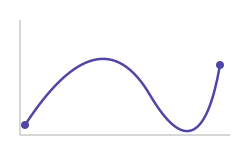
The world at the time.
IMD used statistical and dynamical ensemble models and published uncertainty. Its April outlook anticipated weak El Niño and development of a positive Indian Ocean Dipole.
What happened.
The season produced 110% of the long-period average. That was 14 percentage points above the central estimate and 9 points above the upper error bound.
Predicted vs actual.
| Metric | Predicted | Actual | Variance / caveat |
|---|---|---|---|
| Seasonal rainfall (% LPA) | 96 ± 5 | 110 | +14 percentage points versus midpoint; +9 above upper bound |
The counter-signal.
Skymet’s April 3 forecast put rainfall at 93% and favored a below-normal season. This contemporary disagreement challenged confidence in a normal season, although Skymet also missed the eventual wet outcome.
Verdict.
Reasoning: sound · Outcome: wrong
The numeric central forecast and stated error band failed. The sound rating recognizes transparent models and uncertainty, not a claim that one miss proves or disproves calibration.
Cause of death / explanatory lens.
No cause of death assigned
The lesson.
How should a forecast change when interacting ocean drivers can reverse the late-season trajectory?
Sources.
- IMD first-stage 2019 monsoon forecastprimary · 2019-04-15 · claim/date/method
- IMD monsoon 2020 review, reporting 2019 outcomeprimary · 2020-10-01 · outcome
- Skymet 2019 monsoon forecastprimary · 2019-04-03 · contemporary counter-signal
- The Extreme Positive Indian Ocean Dipole of 2019 and Associated Indian Summer Monsoon Rainfall Responseprimary research · 2021 · causal explanation
Related predictions.
Technology
United States
Environment
United States
Demographics
United States