resolved · Unscored / disputed
Extracting a useful power source from atomic transformations was an unrealistic expectation.
Source-backed summary; not presented as a verbatim quotation.
Ernest Rutherford
Nuclear physicist · New Zealand / United Kingdom
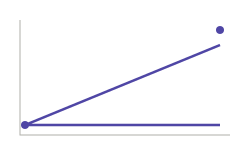
The world at the time.
Rutherford had seen nuclear reactions whose laboratory energy costs exceeded their useful yield. His public dismissal extended that evidence to prospects for practical atomic power.
What happened.
A nuclear reactor generated electricity experimentally in 1951. Obninsk supplied civilian nuclear power in 1954, defeating a broad impossibility reading.
Predicted vs actual.
| Metric | Predicted | Actual | Variance / caveat |
|---|---|---|---|
| Useful atomic electricity | Unrealistic | 1954 civilian power plant | Broad dismissal refuted |
The counter-signal.
Szilard conceived a neutron-multiplying chain reaction immediately after reading the dismissal. That mechanism bypassed the energy economics of individually induced reactions.
Verdict.
Reasoning: contested · Outcome: wrong
Outcome wrong under the broad power-source claim; whether his original reasoning was poor is contested because nuclear fission was still unknown.
Cause of death / explanatory lens.
The lesson.
When does failure of a known mechanism justify ruling out all future mechanisms?
Sources.
- The Mighty Atom, contemporary newspaper dispatchprimary · 1933-09-13 · 12 September dismissal
- Szilard’s eureka momentinstitutional_history · Date not established · contemporary chain-reaction counter-signal
- History of the IAEAinstitutional_history · 1997 · 1951 experimental and 1954 power outcomes
Related predictions.
Demographics
United States
Economics and finance
United States
Science
United States